
Noticing that your toddler is developing differently can bring many questions. You may wonder whether limited speech, reduced eye contact, repetitive play or a strong reaction to sounds is simply a phase or an early sign of autism. Understanding the early signs of autism in toddlers in Bangalore can help parents seek the right guidance without jumping to conclusions.
Autism spectrum disorder (ASD) is a developmental condition that can affect social communication, interaction, play, behaviour and sensory processing. Some children show signs in the first year, while others become more noticeably different between 18 and 24 months. A sign by itself does not diagnose autism. The important point is to observe patterns and discuss concerns early with a qualified professional.
autism assessment for toddlers Bangalore
Autism Spectrum Disorder (ASD) is a neurodevelopmental condition that affects how a child communicates, interacts socially, and processes sensory information. Research consistently shows that the clearest red flags appear between 12 and 36 months. In India, however, diagnosis is frequently delayed, sometimes until school age, because the early window is missed. This article helps Bengaluru families recognise autism signs in toddlers, understand what is often overlooked, and know when to seek autism screening and support.
Why Early Signs of Autism Are Frequently Missed in Bengaluru
Several local factors contribute to delayed recognition of autism symptoms in toddlers:
- Cultural narratives: “Boys speak late” or “she is just very independent” remain common explanations that postpone professional evaluation.
- Busy urban lifestyles: Dual-career households and nuclear families may have fewer opportunities for extended observation of social play.
- Attribution to screens or environment: Reduced interaction is sometimes blamed solely on gadget time rather than investigated further.
- Limited routine developmental surveillance: Not every well-child visit includes structured autism screening.
Understanding these patterns helps parents move from “wait and watch” to timely action when early signs of autism before age 3 are present. Related reading: 5 Early Warning Signs of Developmental Delays in Toddlers.
Core Early Red Flags of Autism Before Age 3
No single behaviour confirms autism. Clinicians look for a pattern across social communication, language, and restricted or repetitive behaviours.
Social Communication Signs
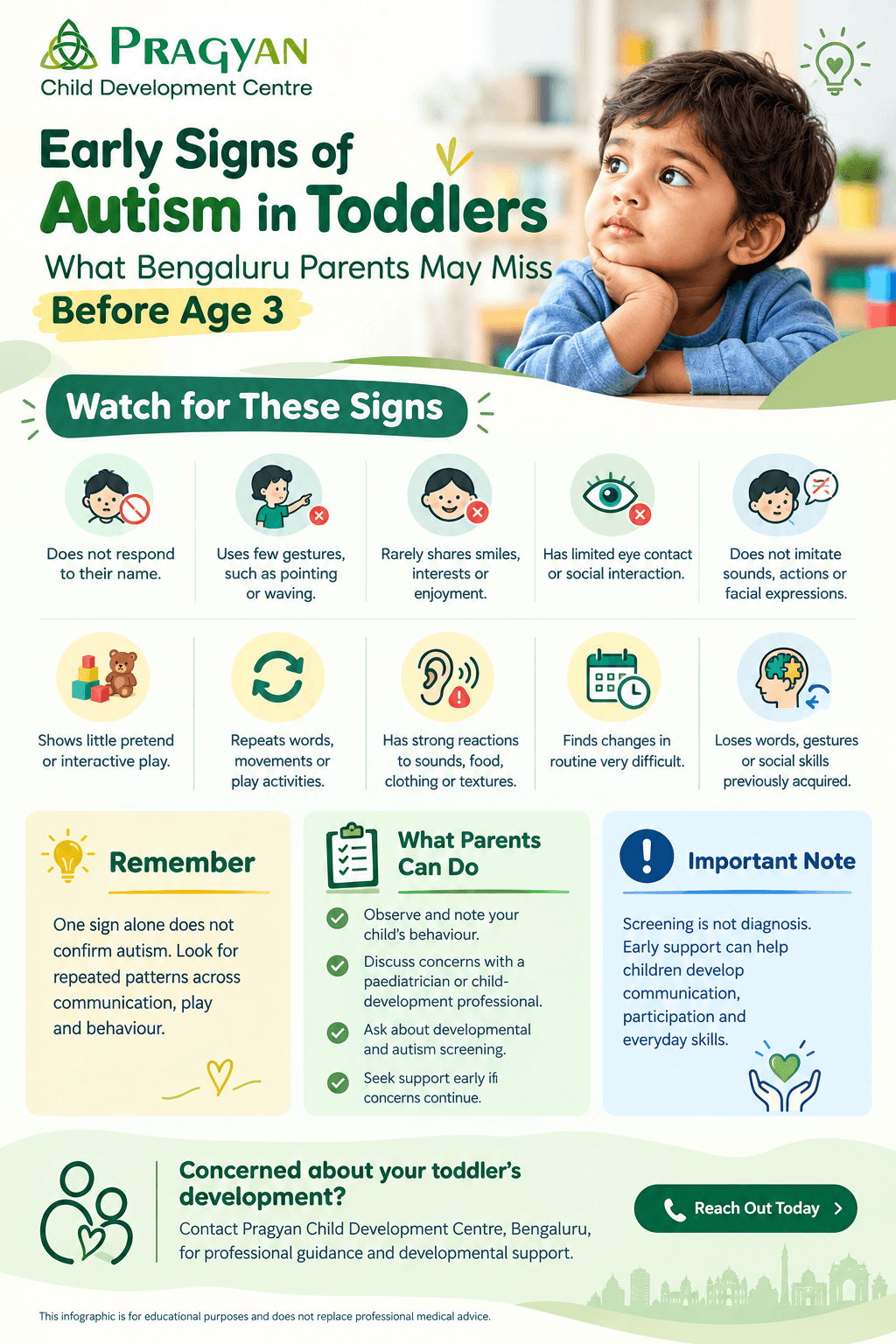
- Limited or inconsistent eye contact during feeding, play, or conversation
- Does not reliably respond to name by 12 months
- Rarely points to show interest (proto-declarative pointing) by 14–18 months
- Few gestures – waving, nodding, or shaking head may be absent
- Prefers solitary play and may seem “in their own world”
- Does not share enjoyment by bringing toys to show parents
- Reduced joint attention – does not follow a parent’s pointing or gaze
Speech and Language Signs
- No single meaningful words by 16 months
- No spontaneous two-word phrases by 24 months
- Echolalia – repeating phrases from videos or adults without clear communicative intent
- Unusual tone, rhythm, or robotic quality of speech
- Uses a parent’s hand as a tool to obtain objects rather than pointing or requesting
- Loss of previously acquired words or social skills (regression) – always an urgent concern
If speech is a primary concern, see our detailed guide: 2-Year-Old Not Talking? Speech Delay & Bangalore Therapy.
Behavioural, Play and Sensory Signs
- Lines up toys or objects rather than engaging in functional or pretend play
- Intense focus on parts of objects (spinning wheels, reflections, lights)
- Repetitive movements – hand-flapping, rocking, spinning, or persistent toe-walking
- Strong distress over minor changes in routine or environment
- Unusual sensory responses – covering ears at everyday sounds, seeking or avoiding certain textures, under- or over-reactivity to pain
These autism red flags in toddlers become clearer when observed consistently across home, family gatherings, and play settings.
Age-Wise Snapshot: What to Watch Between 12 and 36 Months
12–18 months: Absence of babbling, pointing, waving, or consistent name response; limited social smiling and back-and-forth engagement.
18–24 months: Few or no single words, little pretend play, reduced imitation, emerging repetitive behaviours or sensory sensitivities.
24–36 months: No meaningful two-word combinations, limited interest in peers, rigid routines, intense restricted interests, or clear regression. By age 3 many children later diagnosed with autism already show a recognisable pattern of social-communication differences.
Subtle Signs Bengaluru Parents Often Dismiss
Beyond the classic checklist, quieter indicators are frequently rationalised:
- The child appears “very independent” because they rarely seek comfort or share discoveries.
- Excellent visual memory or early interest in letters/numbers is celebrated while social reciprocity lags.
- Using an adult’s hand to open a door or reach a toy is seen as clever rather than a possible alternative to pointing.
- Preference for the same route, same cup, or same sequence of play is attributed to “strong personality.”
When several of these subtle patterns coexist with delayed language or reduced eye contact, a professional developmental look is warranted.
Developmental Delay and Autism Signs – Understanding the Overlap
Developmental delay can affect speech, motor skills, cognition, or social-emotional domains and may or may not be part of autism. Autism is defined by persistent differences in social communication together with restricted, repetitive patterns of behaviour, interests, or sensory responses. A toddler with pure speech delay who points, shares enjoyment, and engages in reciprocal play is less likely to meet autism criteria than a child whose speech delay is accompanied by limited joint attention and repetitive play. Only a structured developmental assessment can clarify the picture and guide the right support.
When and How to Seek Autism Screening for Toddlers in Bangalore
Act promptly if you notice multiple red flags or any regression. Recommended steps include:
- Document specific examples and, if possible, short videos of concerning behaviours.
- Discuss concerns with your paediatrician and request autism-specific screening (tools such as M-CHAT-R/F are commonly used at 18 and 24 months).
- Seek a comprehensive developmental assessment from a developmental paediatrician, child psychologist, or a specialised child development centre.
- Begin early intervention even while waiting for a formal diagnosis – therapy can start based on functional needs.
Families in areas such as Rajajinagar, Yelahanka, Nagasandra, and surrounding neighbourhoods can access multidisciplinary evaluation and therapy without travelling across the city. For East Bengaluru, see our Varthur centre.
How a Child Development Centre Supports Families
A dedicated child development centre offers coordinated care that a single specialist visit cannot provide. At centres such as Pragyan CDC, the process typically includes:
- Screening and detailed developmental assessment to map strengths and challenges across communication, motor, sensory, and behavioural domains.
- Individualised early intervention plans that may combine speech and language therapy, occupational therapy with sensory integration, ABA or behaviour therapy, and parent coaching.
- Family-centred guidance so strategies used in the centre transfer into daily home routines.
With multiple locations across Bengaluru, including Rajajinagar, Yelahanka, Nagasandra and other neighbourhood hubs, consistent therapy becomes practical for busy parents. Early, intensive support before age 3 takes advantage of rapid brain development and maximises long-term gains in communication, social engagement, and independence. Explore all therapy services.
Practical Next Steps for Bengaluru Parents
If you are wondering “how to know if my child has autism,” start with careful observation and professional conversation rather than internet self-diagnosis. Trust your instincts when something feels persistently different. Early recognition is not about labelling a child; it is about understanding their needs and opening access to the right support at the right time.
Pragyan Child Development Centre welcomes families seeking clarity. Whether you need an autism assessment for toddlers near Nagasandra, guidance on autism signs in toddlers in Yelahanka, or ongoing autism therapy for toddlers accessible from Vijayanagar or Rajajinagar, a multidisciplinary team can help you take the next informed step. Contact us or visit the nearest centre listed on our homepage.
Conclusion
The early signs of autism in toddlers are often visible well before age 3, yet they are easy to miss amid everyday explanations and busy schedules. Limited eye contact, absent name response, lack of pointing, delayed or unusual language, repetitive play, and sensory differences form a pattern that deserves professional attention. For Bengaluru parents, recognising these autism red flags and seeking timely screening can change a child’s developmental trajectory.
If concerns have been on your mind, reach out for a developmental assessment. Early support is one of the most powerful gifts a parent can offer. Contact Pragyan CDC to learn about autism screening, assessment, and therapy options across its Bengaluru centres.
Frequently Asked Questions
What are the early signs of autism in toddlers before age 3?
Common concerns include limited response to name, reduced pointing or gestures, limited shared enjoyment, repetitive play, sensory differences, delayed social communication and regression. One sign alone does not diagnose autism.
How do I know if my child has autism in Bangalore?
You cannot confirm autism from an online checklist. Discuss your concerns with a paediatrician or qualified child-development professional for developmental surveillance, screening and, when needed, a comprehensive assessment.
Is speech delay always an autism symptom?
No. Speech delay can have several causes. Autism concerns become more likely when speech differences occur with limited gestures, social reciprocity, joint attention, imitation or repetitive behaviours.
When should a toddler be screened for autism?
Autism-specific screening is commonly considered around 18 and 24 months, alongside ongoing developmental surveillance. A professional may screen earlier or later when concerns arise.
What is the M-CHAT-R/F?
It is a two-stage parent-report screening tool designed to identify toddlers who may need further evaluation. It is not an autism diagnosis.
Can a child have autism without speech delay?
Yes. Some autistic children speak early or use many words but have difficulty with reciprocal conversation, social understanding, flexible play or sensory regulation.
Are repetitive movements always autism red flags?
Not always. Repetitive movements can occur for many reasons. Their frequency, intensity, context and effect on communication or daily life should be considered with other developmental signs.
Can bilingualism cause autism or speech delay?
Bilingualism does not cause autism. Share information about all languages your child hears and uses during a professional assessment.
What is the difference between developmental delay and autism signs?
Developmental delay may affect one or more milestone areas. Autism primarily involves social communication and interaction differences together with restricted or repetitive behaviours, although profiles vary.
Where can I seek autism screening for toddlers in Bengaluru?
Start with your paediatrician or a reputable child development centre. Ask about clinician qualifications, screening tools, assessment pathways, parent involvement and follow-up.
What should I take to a toddler autism consultation?
Take milestone notes, relevant medical and hearing information, daycare feedback, questions and short videos if safe and appropriate. Do not record other children without consent.
Can early therapy cure autism?
Autism is not something to cure. Early support can help a child develop communication, participation, independence and coping skills, with goals tailored to the child and family.
What therapies may help autistic toddlers?
Depending on the child’s needs, support may include speech and language therapy, occupational therapy, parent coaching, behaviour support and educational interventions. A professional should guide the plan.
Are autism signs in toddlers different in Rajajinagar or Yelahanka?
Developmental signs are not location-specific. Families in Rajajinagar, Yelahanka and other Bengaluru areas can seek local consultation for convenience and continuity of care.
When should I seek urgent advice?
Seek prompt professional advice after regression, loss of language or social skills, significant feeding or sleep concerns, safety risks, seizures or any sudden developmental change.