

A Realistic Timeline for Parents
One of the first things parents ask after they start therapy is some version of: “Okay, but when will we actually see something change?”
It’s a fair question. You’ve rearranged schedules, maybe taken time off work, and you’re putting a lot of hope (and money) into this. You want a straight answer. The problem is there isn’t one clean number that works for every child.
Speech therapy, occupational therapy, and ABA all move at different speeds depending on the kid, the goal, how consistent you are, and what else is going on at home. What follows is a realistic look at what most families actually experience—not the best-case marketing version.
occupational therapy in Bangalore.
Why the Timeline Varies So Much
A few things matter more than people admit:
- How old the child is when you start. Younger kids (especially under five) usually pick things up faster.
- Whether you’re working on one specific skill or a bunch of overlapping ones.
- How often you actually make it to sessions without long gaps.
- Whether anyone is practicing the strategies at home between appointments.
- How well the different therapists talk to each other if your child is doing more than one type of therapy.
Skip home practice or miss a lot of sessions and everything slows down. That’s just reality.
Speech Therapy – What Parents Usually See
Mild sound errors (the classic “wabbit” for rabbit kind of thing)
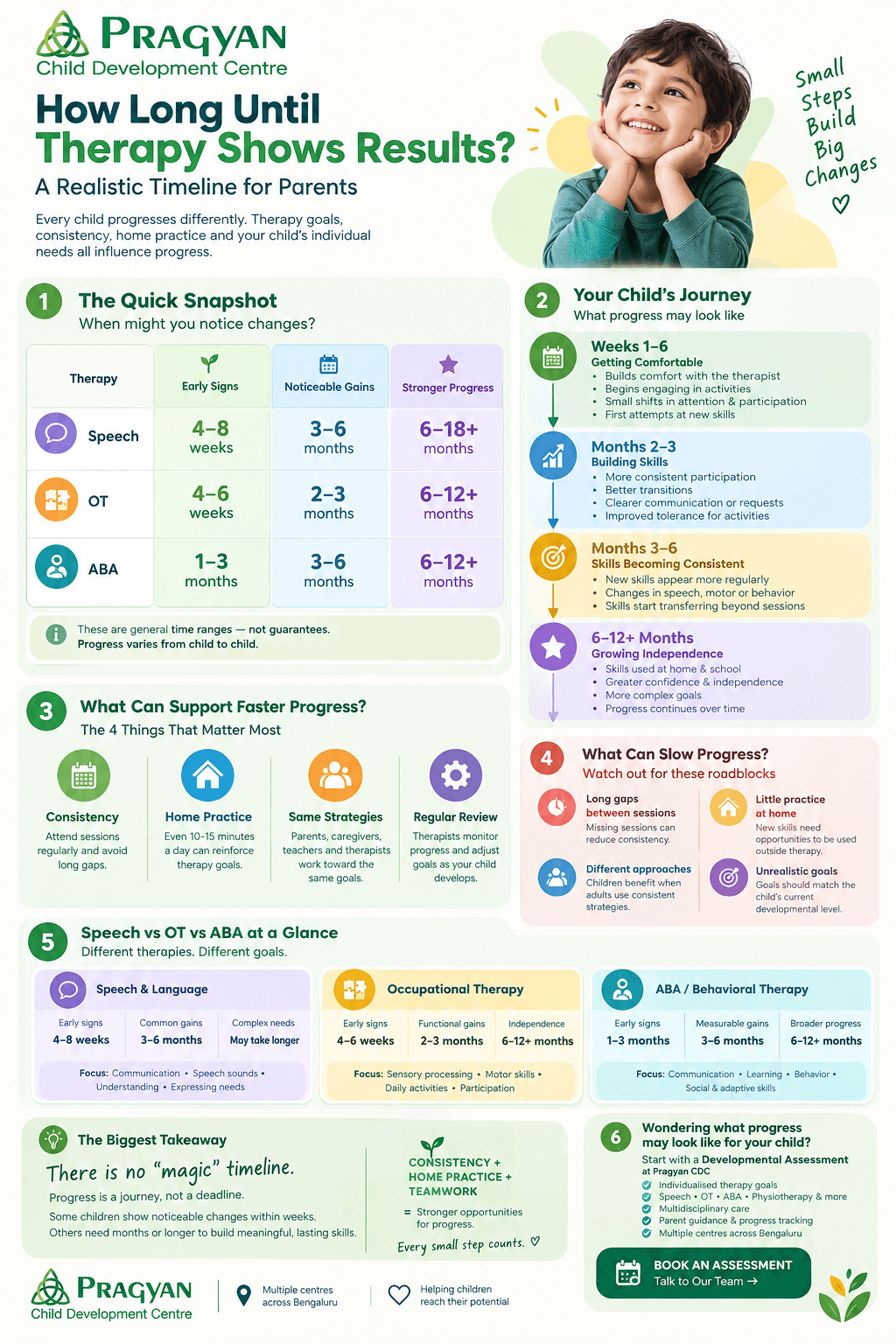
A lot of kids show clear improvement in three to six months of weekly sessions if someone is practicing with them at home. Some simpler single-sound goals wrap up even faster—eight to twelve sessions if everything lines up. More complicated sound patterns can stretch to a year or more.
Language delays and bigger communication needs
This is where timelines get longer. Toddlers and preschoolers who are late to talk or struggle to understand language often need six months to two years. Kids with autism-related communication challenges or childhood apraxia usually need even longer—sometimes measured in years rather than months. Early intervention before age three still gives the best shot at faster gains.
You’ll usually get progress updates every eight to twelve weeks so goals can be adjusted. If nothing is moving after a few months of consistent work, it’s time to ask why.
Related reading: 2-Year-Old Not Talking? Speech Delay & Bangalore Therapy
Occupational Therapy – The Realistic Pace
Parents often notice small shifts in the first four to six weeks: the child sits a little longer, grips a crayon better, or melts down a bit less during messy play or transitions.
By two to three months you start seeing clearer changes—better fine-motor control, more willingness to try self-care tasks, or less sensory overwhelm in everyday situations. Real lasting independence usually takes six to twelve months or longer, especially if sensory processing or motor planning is a big piece of the picture.
Mild, focused goals can sometimes finish in three to six months. Kids with autism, significant developmental delays, or complex sensory needs often stay in OT for years, with the goals simply changing as the child grows.
Learn more about pediatric occupational therapy in Bangalore.
ABA Therapy – What the First Year Often Looks Like
Most families notice early signs within the first one to three months: the child engages more during sessions, refuses less, handles transitions a little better, or starts trying new ways to ask for things.
Between three and six months the changes become more measurable—following directions more consistently, using clearer requests, or getting through previously hard routines with less drama. From six to twelve months those skills start showing up outside the therapy room—at home, at school, in the grocery store.
Bigger independence and social communication skills keep building over one to three years (sometimes longer), depending on how intensive the program is and where the child started. Comprehensive programs for younger kids or those needing a lot of support often run for several years with goals that evolve. More focused ABA can be shorter.
Explore ABA therapy in Bangalore for how plans are structured and reviewed.
A Rough Month-by-Month Picture
Weeks 1–6
Mostly getting to know each other, figuring out baselines, and spotting the first tiny shifts—better attention, a little more willingness to try, occasional new attempts at communication or motor tasks.
Months 2–3
Early changes start feeling more consistent. Parents often mention calmer transitions or clearer requests.
Months 3–6
Skills begin sticking in structured settings. Vocabulary grows, fine-motor tasks get easier, or certain behaviors happen less often or with less intensity.
Months 6–12 and beyond
The real test: does the skill show up with different people and in different places? This is when generalization starts happening—if the team and family are working on it deliberately.
What Actually Speeds Things Up (and What Slows Them Down)
Progress moves faster when sessions are consistent, someone is doing short daily practice at home, the adults are using the same strategies, and goals get reviewed and adjusted regularly.
It slows down with frequent missed sessions, almost no practice between visits, different adults doing different things, or goals that are either too vague or too advanced for where the child is right now.
Plateaus are normal. If you’ve been consistent for eight to twelve weeks and nothing is shifting, ask for a formal progress review instead of just waiting longer.
If you’re also watching for early warning signs of developmental delays, addressing concerns early through early intervention generally leads to faster and more durable gains.
Why Doing Speech, OT, and ABA Together Can Help
When the therapies stay completely separate, skills often stay stuck in the therapy room. When the speech therapist, OT, and ABA team actually share goals, things tend to move faster. Communication targets get practiced during motor and sensory activities. Sensory strategies help the child stay regulated enough to learn. Behavioral approaches support the attention needed for speech practice.
That kind of coordination is one of the real advantages of a multidisciplinary center rather than piecing services together from different places. Families can access the full range of pediatric therapy services under one coordinated plan across Bengaluru locations.
What Bangalore Parents Can Do Next
Start with a solid developmental assessment so the goals match your child instead of a generic checklist. Look for a place that can offer speech, OT, and ABA when needed, that tracks progress in a way you can understand, and that treats parents as part of the team rather than just drop-off people.
Consistency usually beats intensity in the long run.
If you’re looking for coordinated speech, occupational, and ABA therapy in Bangalore, Pragyan Child Development Centre works with families across multiple locations. You can start with an assessment and get a realistic picture of what the next few months might look like for your specific child. Contact us or visit www.pragyancdc.com to find the nearest centre.
Conclusion
There’s no magic number of weeks that guarantees results. Mild goals can move in a few months. More complex developmental or autism-related goals often need sustained work measured in years. What stays true is that starting earlier, showing up consistently, practicing at home, and having therapists who talk to each other gives kids the best chance of steady, meaningful progress.
Use the timelines above as a guide, not a stopwatch. And stay in conversation with the team about what’s actually working.
Frequently Asked Questions
How long does speech therapy take for children to show results?
Mild articulation issues may improve in 3–6 months. Language delays and more complex needs often require 6–24 months of consistent therapy with home practice.
How long does ABA therapy take to show results?
Early signs often appear within 1–3 months. Measurable gains are common by 3–6 months; broader progress builds over 6–12 months and beyond.
How long does occupational therapy take for children?
Early changes may be visible in 4–6 weeks. Clearer functional gains typically emerge by 2–3 months, with lasting development over 6–12+ months.
Does more frequent therapy mean faster results?
Generally yes for intensity-sensitive goals, but consistency and quality of sessions plus home practice matter more than simply adding hours without a clear plan.
How important is home practice for therapy progress?
Very important. Short daily practice (even 10–15 minutes) significantly accelerates and generalizes skills learned in speech, OT, and ABA sessions.
What if my child is not showing progress after 3 months?
Request a formal progress review. Goals, strategies, or frequency may need adjustment. Plateaus are common and do not always mean therapy is ineffective.
Where can I get speech, OT, and ABA therapy for children in Bangalore?
Pragyan Child Development Centre offers coordinated speech, occupational, and ABA therapy across multiple Bengaluru locations. Visit www.pragyancdc.com or contact us to begin.