
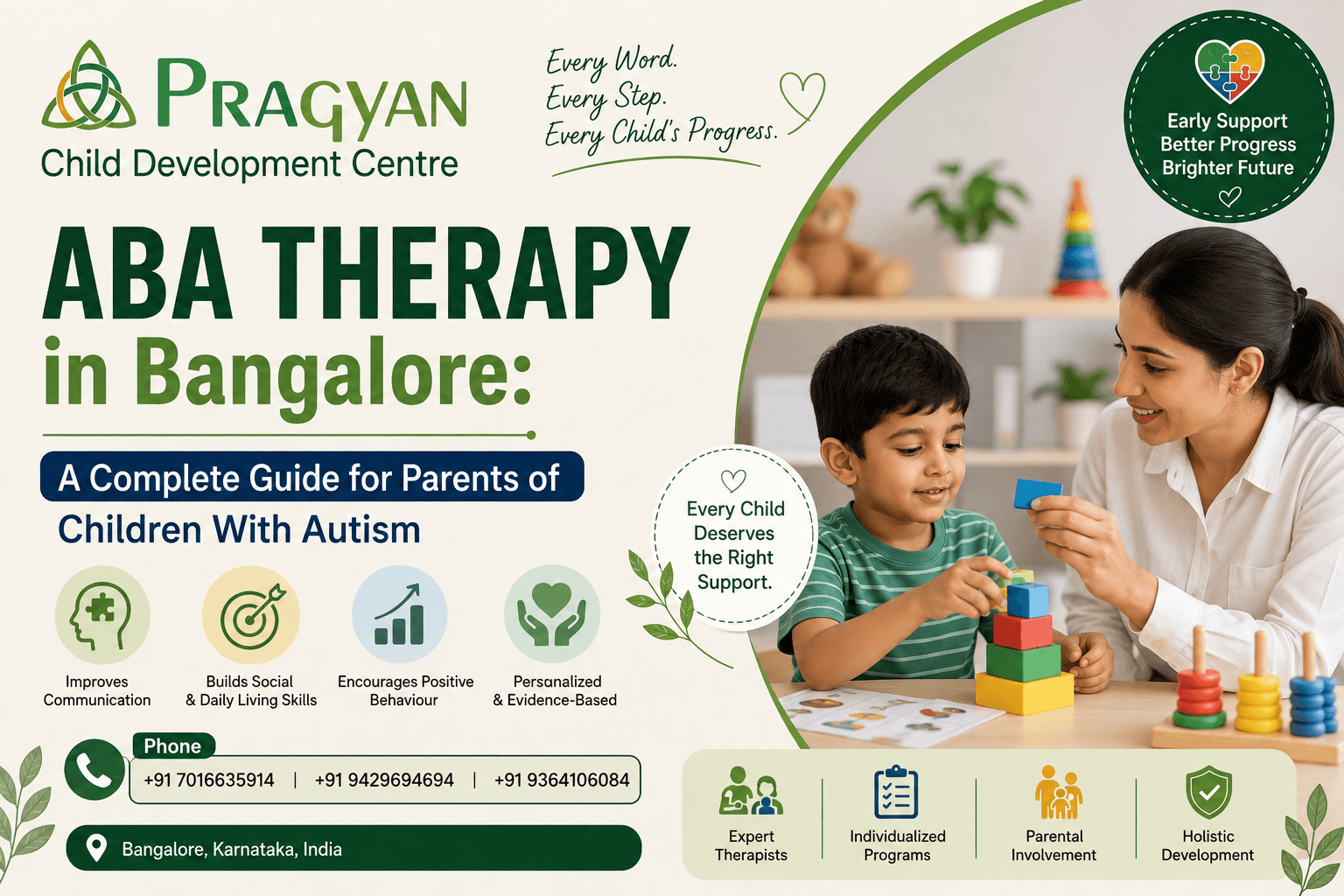
Receiving an Autism Spectrum Disorder (ASD) diagnosis for your child brings both clarity and a new set of questions. As a parent navigating options in Bangalore, you will frequently hear about Applied Behavior Analysis (ABA). Widely regarded as one of the most effective, research-backed frameworks for autism intervention, ABA therapy helps children build communication, social skills, and daily self-reliance.
However, choosing the right clinic, understanding session structures, and incorporating home techniques require clear guidance. This parent-focused guide breaks down how ABA therapy in Bangalore functions, what to expect during sessions, and how to select the best center for your family.
What is Applied Behavior Analysis (ABA) Therapy?
Applied Behavior Analysis is an evidence-based therapeutic approach focused on understanding how behavior works, how it is affected by the environment, and how learning takes place.
Rather than focusing on rigid repetition, modern applied behavior analysis Bangalore programs focus on positive reinforcement. When a desired behavior (such as making eye contact, using words to request a toy, or completing a self-care task) is followed by a meaningful reward, the child is motivated to repeat that behavior.
Core Goals of ABA Therapy:
Communication Skills: Encouraging vocal speech, picture exchange systems (PECS), or assistive device usage.
Social Engagement: Teaching joint attention, sharing, eye contact, and peer interaction.
Life & Adaptive Skills: Supporting independent feeding, dressing, grooming, and toilet training.
Reduction of Maladaptive Behaviors: Minimizing self-harm, severe tantrums, aggression, or unsafe escape behaviors by addressing their root causes.
Key Components of a Quality ABA Program
When visiting an autism therapy center Bangalore parents trust, ensure the program includes these essential elements:
+-----------------------------------------------------------------------------------+
| 1. Functional Behavior Assessment (FBA)                                           |
| Identifies the underlying triggers and motivators behind a child's behavior.      |
+-----------------------------------------------------------------------------------+
                                         │
                                         ▼
+-----------------------------------------------------------------------------------+
| 2. Individualized Behavior Plan (BIP)                                             |
| Establishes measurable goals tailored to the child's developmental profile.        |
+-----------------------------------------------------------------------------------+
                                         │
                                         ▼
+-----------------------------------------------------------------------------------+
| 3. One-on-One Direct Intervention                                                 |
| Delivers targeted skill-building trials through structured and naturalistic play. |
+-----------------------------------------------------------------------------------+
                                         │
                                         ▼
+-----------------------------------------------------------------------------------+
| 4. Continuous Data Collection & Review                                            |
| Tracks daily progress metrics to refine strategies in real time.                  |
+-----------------------------------------------------------------------------------+
                                         │
                                         ▼
+-----------------------------------------------------------------------------------+
| 5. Parent & Caregiver Training                                                    |
| Equips families with strategies to maintain consistency across home environments. |
+-----------------------------------------------------------------------------------+
Modern ABA vs. Traditional Approaches
ABA therapy has evolved significantly over recent years. Modern, progressive practices prioritize the child’s emotional comfort, natural play, and intrinsic motivation.
| Feature | Traditional ABA Therapy | Modern Naturalistic ABA Therapy |
| Primary Environment | Sitting at a desk (Discrete Trial Training) | Play areas, natural home settings, and group spaces |
| Therapist Role | Strict instruction instructor | Facilitator building rapport through play (“pairing”) |
| Motivation Source | Standardized external rewards | Child-led interest activities (toys, blocks, games) |
| Focus | Task completion and repetition | Communication, functional independence, and emotional regulation |
What Happens During a Standard ABA Therapy Session?
A standard session at a dedicated center typically lasts 1 to 2 hours, designed to maintain engagement while avoiding sensory exhaustion:
Rapport Building & Pairing (10 Mins): The therapist engages in the child’s preferred activities to establish comfort and trust.
Structured Skill Development (20–30 Mins): Breaking complex skills (like matching colors or asking for water) into small steps using positive reinforcement.
Natural Environment Training (20–30 Mins): Practicing turn-taking or vocal requests during open play or sensory gym activities.
Self-Care & Functional Practice (15 Mins): Working on practical activities such as opening a lunchbox or washing hands.
Cool-down & Parent Debrief (10 Mins): Transitioning smoothly out of therapy while sharing progress updates with the parent.
How to Select the Best ABA Therapy Center in Bangalore
Bangalore offers various developmental setups across major corridors including Indiranagar, HSR Layout, Koramangala, Whitefield, Jayanagar, and Rajajinagar. Consider these factors when choosing a center:
1. Board Certification & Supervisor Oversight
Check if the clinic’s programs are designed or supervised by a Board Certified Behavior Analyst (BCBA) or qualified clinical psychologists specializing in behavioral modification.
2. Multi-Therapy Integration
Autism management works best when ABA is coordinated alongside Speech Therapy, Occupational Therapy, and Sensory Integration. Choose centers offering an integrated team approach under one roof.
3. Parent Involvement and Open Door Policies
Top centers encourage parents to observe sessions or provide dedicated observation spaces, along with regular home-program training.
4. Transition & School Readiness Support
Ask whether the center provides school readiness modules or shadow-teaching support to help your child adapt to mainstream preschool or school environments.
Frequently Asked Questions (FAQs)
1. What is ABA therapy, and how does it help children with autism in Bangalore?
Applied Behavior Analysis (ABA) is a scientifically validated, data-driven therapeutic framework designed to improve communication, social interaction, academic readiness, and adaptive daily living skills. ABA therapy in Bangalore focuses on positive reinforcement to build functional behaviors while reducing safety risks or challenging meltdowns by understanding their root causes.
2. What is the ideal age to begin early intervention autism therapy in Bangalore?
Early intervention specialists recommend starting ABA therapy as early as 18 to 24 months. Because brain plasticity is highest during ages 1 through 5, early behavioral intervention yields the most significant long-term progress in language acquisition, social development, and independence.
3. How much does ABA therapy cost per hour or month in Bangalore?
On average, 1-on-1 ABA therapy sessions in Bangalore range from ₹600 to ₹2,000 per hour, depending on therapist credentials, clinic facilities, and supervisor oversight. Comprehensive monthly centers running 10 to 25 hours per week typically range between ₹15,000 and ₹45,000 per month.
4. What qualifications should I look for in an ABA therapist or BCBA therapist in Bangalore?
Look for centers where programs are designed or supervised by a Board Certified Behavior Analyst (BCBA), Qualified Behavior Analyst (QBA), or a clinical psychologist. Direct 1-on-1 therapists should ideally hold certifications as Applied Behavior Analysis Technicians (ABAT), International Behavior Therapists (IBT), or Registered Behavior Technicians (RBT).
5. How many hours of ABA therapy does my child need each week?
Therapy hours depend on your child’s Functional Behavior Assessment (FBA). Focused ABA programs addressing specific targets (such as toilet training or vocal requests) run 5 to 12 hours per week, while Early Intensive Behavioral Intervention (EIBI) for toddlers usually runs 15 to 25 hours weekly.
6. What is the difference between traditional ABA and modern play-based ABA?
Traditional ABA relied heavily on desk-based repetition (Discrete Trial Training). Modern applied behavior analysis Bangalore centers prioritize Natural Environment Training (NET). Modern ABA uses play, child-led interests, and sensory gym activities to teach communication and social skills organically without stress or forced compliance.
7. Can ABA therapy help my child if they are non-verbal?
Yes. ABA therapy helps non-verbal children develop functional communication systems (FCT). Therapists use picture cards (PECS), vocal approximations, sign gestures, or Augmentative and Alternative Communication (AAC) speech devices to allow children to express their wants and needs, reducing frustration and meltdowns.
8. Does ABA therapy assist with school readiness and classroom transition in Bangalore?
Yes. Many autism therapy center Bangalore facilities offer dedicated school readiness programs. Therapists work on group sitting tolerance, instruction-following, pencil grip, self-care, and peer interaction, and some provide shadow teacher support to help children adapt to mainstream classrooms.
9. How do therapists manage meltdowns or sensory overstimulation during sessions?
Rather than punishing or ignoring the child, qualified ABA therapists conduct a Functional Behavior Assessment (FBA) to identify sensory or emotional triggers. They introduce self-regulation techniques, sensory breaks, and alternative communication tools to prevent sensory overload safely.
10. How long will my child need to attend an ABA therapy center?
Therapy duration varies according to individualized goals. Some children achieve target functional milestones within 6 to 12 months, whereas others with broader developmental needs benefit from ongoing, structured support over 1 to 3 years.
11. Can parents sit in or observe ABA therapy sessions in Bangalore?
Yes. Progressive clinics maintain open-door policies or offer observation windows. Transparent parent involvement is vital, as observing techniques allows families to replicate strategies consistently at home.
12. Are center-based or home-based ABA therapy sessions better?
Center-based ABA: Best for social interaction, access to specialized sensory gym equipment, and school simulation.
Home-based ABA: Ideal for toddlers, addressing home-specific routines (bedtime, eating, toilet training), or families with travel constraints.
13. Is ABA therapy effective for children diagnosed with ADHD?
Yes. ABA principles effectively build executive function, emotional regulation, impulse control, and attention span for children with ADHD, helping them manage impulsivity and stay engaged in academic tasks.
14. What is the role of parent training in Applied Behavior Analysis?
Parent training ensures skills learned in therapy carry over into real-life settings. Therapists teach parents positive reinforcement strategies, routine mapping, and crisis management so home environments match clinic progress.
15. Where are the top autism therapy centers located in Bangalore?
Leading child development and ABA centers operate across major residential hubs, including Indiranagar, Koramangala, HSR Layout, Whitefield, JP Nagar, Jayanagar, Rajajinagar, and Yelahanka.
16. How does ABA therapy integrate with speech and occupational therapy?
Autism care is most successful when multidisciplinary. Occupational therapists work on sensory motor development, speech pathologists address articulation and language mechanics, and ABA therapists reinforce those target skills using structured behavioral techniques during daily activities.
17. Is ABA therapy covered by health insurance in India?
Outpatient developmental therapies are increasingly covered under modern corporate healthcare policies and comprehensive private health insurance schemes upon official diagnosis and referral by a developmental pediatrician. Always check directly with your insurance provider.
18. What happens during an initial ABA assessment?
A certified supervisor conducts an initial evaluation over 1 to 2 sessions. The therapist interacts with the child through play, conducts an FBA to assess strengths and skill gaps, interviews the parents, and creates an Individualized Behavior Plan (BIP).
19. Can online or remote ABA therapy work for my child?
Telehealth/remote ABA therapy works best for older children (ages 6+) who can engage virtually, or as a direct coaching model where a behavior analyst guides parents via video calls to implement interventions at home.
20. How can I measure my child’s progress in ABA therapy?
ABA is data-driven. Therapists record data during every session on target goals (e.g., frequency of eye contact, vocal requests, or completed tasks). Parents receive weekly or monthly graphical reports reflecting measurable behavioral progress.