
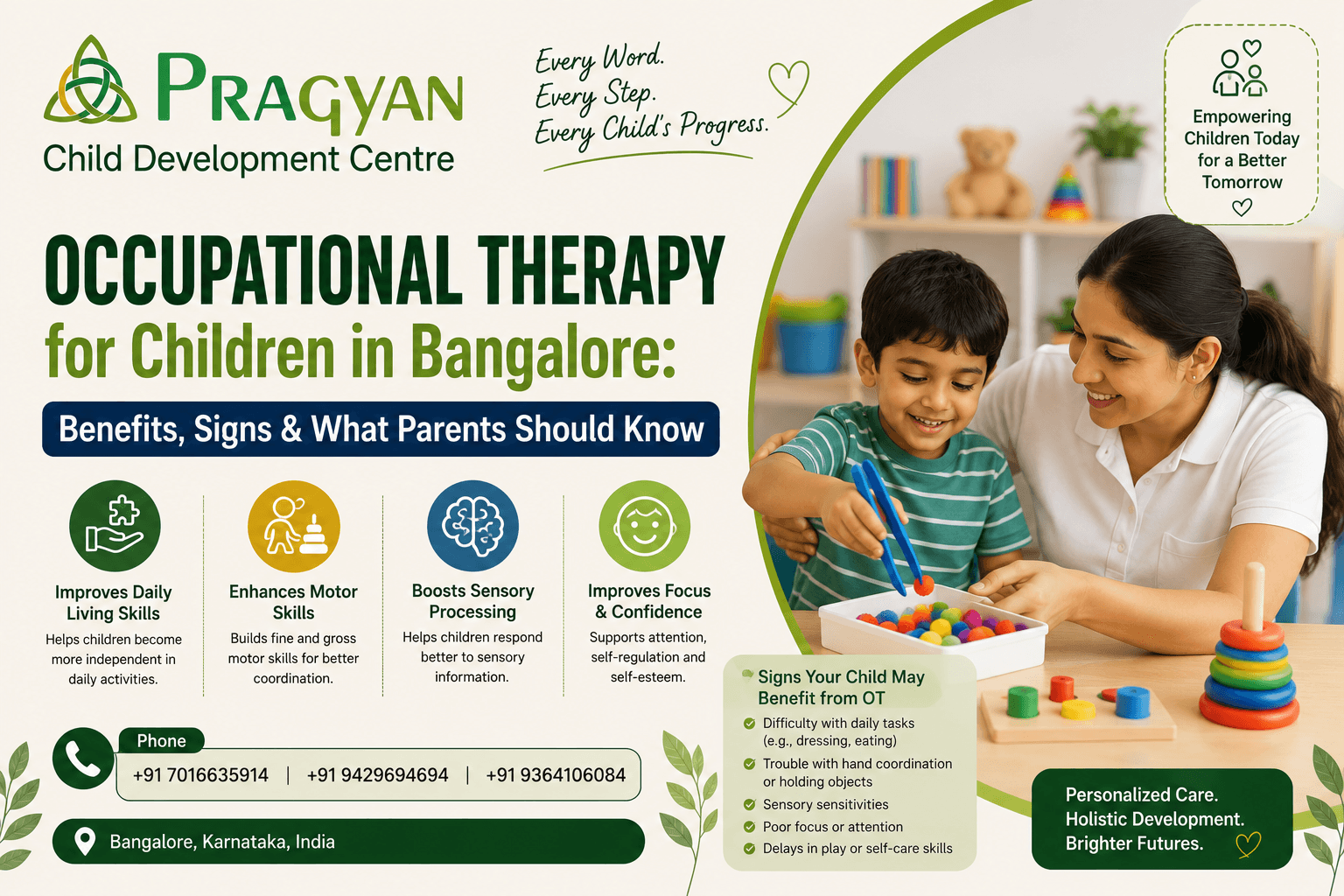
Children learn, connect, and explore the world around them through play, movement, and physical interaction. For a growing child, “occupations” are not professional jobs they are the fundamental, functional activities of childhood. These include holding a spoon, buttoning a school shirt, catching a ball, writing legibly, sitting attentively at a classroom desk, and managing daily personal hygiene. When developmental, physical, or sensory processing challenges interfere with these routines, children often experience deep frustration, low self-esteem, and social or academic delays.
If you are a parent exploring occupational therapy for kids in Bangalore, understanding how this specialized therapy works will empower you to make informed decisions for your child’s growth. This comprehensive guide details what pediatric occupational therapy is, the core domains it addresses, key benefits, early signs to watch for, and how a standard therapy session structured in Bangalore works.
Understanding Pediatric Occupational Therapy
Pediatric occupational therapy is a medical and developmental health discipline that evaluates and supports a child’s physical, sensory, cognitive, and motor abilities. The primary goal is to foster total functional independence in daily routines at home, at school, and on the playground.
Rather than relying on repetitive drills, certified pediatric occupational therapists utilize therapeutic play, sensory gym environments, and targeted motor exercises. By breaking complex daily tasks down into manageable physical and cognitive steps, occupational therapists build a child’s confidence while strengthening their underlying nervous and musculoskeletal systems.
An OT center for children Bangalore parents trust typically focuses on three primary developmental domains:
1. Fine Motor Skills & Hand Function
Fine motor skills involve the coordination of small muscles in the fingers, hands, and wrists. These skills are essential for academic performance and self-care routines. Occupational therapists focus on:
Developing proper pincer grasps for holding pencils, crayons, and utensils.
Building hand and finger strength through manipulation of therapy putty, clay, and small tools.
Improving bilateral coordination using both hands together to cut with scissors, stabilize paper, or button a shirt.
Enhancing eye-hand coordination for precise visual-guided tasks like stringing beads, tracing, and typing.
2. Gross Motor Skills & Postural Control
Gross motor skills involve the large muscle groups responsible for whole-body movement, balance, and spatial coordination. Strong gross motor foundations are necessary for sitting upright in class and playing sports. Key focus areas include:
Strengthening core abdominal and back muscles to prevent slouching at school desks.
Enhancing static and dynamic balance (standing on one foot, navigating balance beams).
Improving motor planning the brain’s ability to plan and execute multi-step physical actions like climbing ladders or navigating an obstacle course.
Building shoulder girdle stability to support fine motor wrist and hand control.
3. Sensory Processing & Integration
Sensory processing refers to how the nervous system receives, organizes, and responds to information from the environment and the body. Many children who require OT struggle with sensory processing differences. Therapists work with seven distinct sensory systems:
Visual & Auditory: Processing sight and sound without becoming overwhelmed or distracted.
Tactile: Tolerating different skin textures, clothing fabrics, grooming tasks, and messy play.
Vestibular: Processing movement, balance, and gravity through head position changes.
Proprioceptive: Understanding body position, joint pressure, and regulating physical force.
Interoception: Recognizing internal body signals such as hunger, thirst, and bladder fullness.
Key Benefits of Occupational Therapy for Children
Investing in pediatric occupational therapy Bangalore services provides structured, long-term advantages that extend far beyond clinic visits into home and classroom environments:
Improved Handwriting & Academic Endurance: By strengthening shoulder stability, wrist extension, and finger dexterity, OT resolves pencil grip issues and hand fatigue, allowing children to write legibly and keep pace with school demands.
Enhanced Sensory Regulation & Emotional Balance: Through sensory integration therapy Bangalore programs, children learn to process environmental inputs efficiently. This significantly reduces sensory overload, anxiety, and frequent emotional meltdowns.
Greater Daily Independence (Self-Care Skills): Children gain the physical mastery needed to feed themselves with utensils, dress, tie shoelaces, brush teeth, and manage personal hygiene independently.
Improved Posture & Focus: Building core muscle strength allows children to sit comfortably at a school desk for extended periods without constant fidgeting or leaning on walls.
Boosted Social Confidence & Peer Interaction: Mastering play skills, playground navigation, and physical coordination reduces frustration, boosting a child’s self-esteem during peer play and group activities.
Early Signs Your Child May Need Occupational Therapy
Recognizing developmental red flags early enables parents to seek timely intervention when neuroplasticity is highest. Consider scheduling a professional evaluation if your child shows persistent difficulties in these areas:
Handwriting and Fine Motor Struggles: Struggling to hold a pencil correctly, extreme hand fatigue when writing, awkward scissor control, or actively avoiding drawing, coloring, and crafting activities.
Sensory Oversensitivity (Hyper-responsiveness): Extreme distress triggered by loud noises, bright lighting, clothing tags, seam lines in socks, sticky hands, or avoiding textures like mud, sand, or wet food.
Sensory Undersensitivity (Hypo-responsiveness): Constantly craving intense physical movement (spinning, jumping, crashing into furniture), unusually high pain tolerance, or unawareness of personal physical space.
Poor Coordination and Clumsiness: Frequent tripping, bumping into doorways and furniture, difficulty climbing stairs, or inability to catch or kick a ball compared to age-matched peers.
Weak Core Muscle Tone: Slouching at school desks, resting head on arms while writing, leaning against walls during standing activities, or tiring easily during normal play.
Self-Care Delays: Difficulty learning how to button shirts, zip jackets, tie shoes, open lunchboxes, or handle eating utensils by expected ages.
Structure of a Standard Occupational Therapy Session
A standard session at a top pediatric clinic in Bangalore runs for 45 to 60 minutes and is structured as engaging, goal-directed play:
Sensory Warm-Up (15 Minutes): The therapist utilizes suspension swings, ball pits, trampolines, or balance boards to organize the child’s nervous system and regulate arousal levels.
Motor Planning & Core Work (15 Minutes): The child navigates custom obstacle courses, climbs walls, or pushes weighted carts (“heavy work”) to build core stability and spatial awareness.
Fine Motor & Visual-Motor Practice (15 Minutes): Targeted table-top activities such as pincer grasp games, playdough manipulation, bead threading, and handwriting worksheets build precision and hand strength.
Cool-Down & Parent Debrief (10 Minutes): The session concludes with calming deep-pressure activities. The therapist provides the parents with direct feedback and practical home activities (“sensory diets”) to reinforce progress daily.
Conclusion: Supporting Your Child’s Journey to Independence
Occupational therapy provides children with the physical, sensory, and motor tools they need to navigate everyday life with confidence and ease. By identifying developmental red flags early and partnering with certified pediatric occupational therapists in Bangalore, you establish a solid foundation for your child’s lifelong independence, academic success, and social well-being.
FAQs for Parents:
1. What is the difference between physical therapy and occupational therapy for kids?
Physical therapy focuses on lower-body strength, gross motor milestones, and gait (walking/running). Occupational therapy focuses on upper-body strength, fine motor skills, hand-eye coordination, sensory processing, and daily life independence.
2. What age can a child start occupational therapy in Bangalore?
Children can start as early as 6 to 12 months for sensory feeding issues or muscle tone challenges. Early intervention between ages 2 and 5 delivers optimal results.
3. What is sensory integration therapy in Bangalore?
Sensory integration therapy Bangalore programs use specialized play equipment (swings, tactile pits, weighted vests) to help the brain process and organize sensory inputs, reducing meltdowns and overstimulation.
4. How do I know if my child has Sensory Processing Disorder (SPD)?
If your child shows extreme reactions to sounds, clothing tags, textures, bright lights, or craves constant crashing and spinning, an OT assessment can identify SPD.
5. Can occupational therapy help improve my child’s handwriting?
Yes. Occupational therapists analyze pencil grip, shoulder stability, finger dexterity, and visual-motor integration to fix poor handwriting and hand fatigue.
6. How much does an occupational therapy session cost in Bangalore?
Individual OT sessions in Bangalore typically range from ₹600 to ₹1,800 per session, depending on the clinic facility, therapist experience, and location.
7. How many sessions of OT will my child need per week?
Most children attend 2 to 3 sessions per week initially. Duration and frequency are adjusted based on progress and initial evaluation recommendations.
8. What qualifications should an occupational therapist have in India?
Therapists should hold a recognized Bachelor of Occupational Therapy (BOT) or Master of Occupational Therapy (MOT) degree from an accredited university.
9. Is occupational therapy effective for children with Autism (ASD)?
Yes. OT is fundamental for children with ASD to address sensory processing differences, self-care routines, fine motor development, and emotional regulation.
10. Can OT help children with ADHD?
Yes. OT helps kids with ADHD build impulse control, self-regulation, body awareness, and focus techniques using sensory diets and motor activities.
11. What is a ‘sensory diet’ in occupational therapy?
A sensory diet is a personalized sequence of daily sensory activities (deep pressure, jumping, heavy work) designed to keep a child calm and focused throughout the day.
12. How long does it take to see results from occupational therapy?
Initial improvements in emotional regulation or routine compliance are often seen within 8 to 12 weeks, while fine motor and handwriting mastery may take 6 months or longer.
13. Can parents sit in during occupational therapy sessions?
Yes, many centers allow observation so parents can learn home exercises and maintain consistency outside the clinic.
14. What equipment is used in a pediatric OT sensory gym?
A sensory gym typically features suspension swings, ball pits, climbing walls, trampolines, therapy balls, weighted blankets, and tactile play stations.
15. Can occupational therapy assist with feeding difficulties and picky eating?
Yes. OTs trained in sensory feeding therapy help children overcome food texture aversion, oral motor weakness, and extreme picky eating habits.
16. Where can I find top pediatric OT centers in Bangalore?
Leading centers are located across major residential hubs, including Indiranagar, HSR Layout, Koramangala, Whitefield, Jayanagar, JP Nagar, and Rajajinagar.
17. Does school-based OT exist in Bangalore?
Some inclusive and progressive private schools in Bangalore retain full-time or visiting occupational therapists to support children directly on school premises.
18. What happens during an initial OT evaluation?
The therapist assesses muscle tone, fine/gross motor skills, sensory processing profiles, visual-spatial skills, and interviews parents about home routines.
19. How can I practice OT exercises with my child at home?
Therapists prescribe home activity plans—such as playing with playdough, animal walks, pouring water, threading beads, and swing time—to reinforce therapy goals.
20. Is occupational therapy covered by health insurance in India?
Coverage varies. Some corporate wellness policies and comprehensive health insurance plans reimburse outpatient OT expenses when prescribed by a doctor.