
Understanding Milestones: What Constitutes a Developmental Delay?
Every child grows, explores, and interprets the world at an individual rhythm. However, pediatric medical frameworks establish clear temporal markers known as child developmental milestones. These milestones span physical movements, speech patterns, cognitive processing, and social interactions. When a child consistently falls behind their age-matched peers in acquiring these foundational skills, it may point toward a developmental delay. For families navigating these concerns, identifying developmental delay signs in a child is the first step toward finding specialised support at a dedicated child development centre in Bangalore.
Crucially, identifying developmental delay signs in a child does not instantly indicate a permanent condition. A delay implies that the child is moving through the standard sequence of skill acquisition at a slower pace. By recognizing these signs early, parents can transition from a state of anxious uncertainty into a clear, structured action plan. Early detection provides the ultimate window of opportunity to implement high-impact therapies that help children catch up effectively.
Speech Therapy for Children in Bengaluru
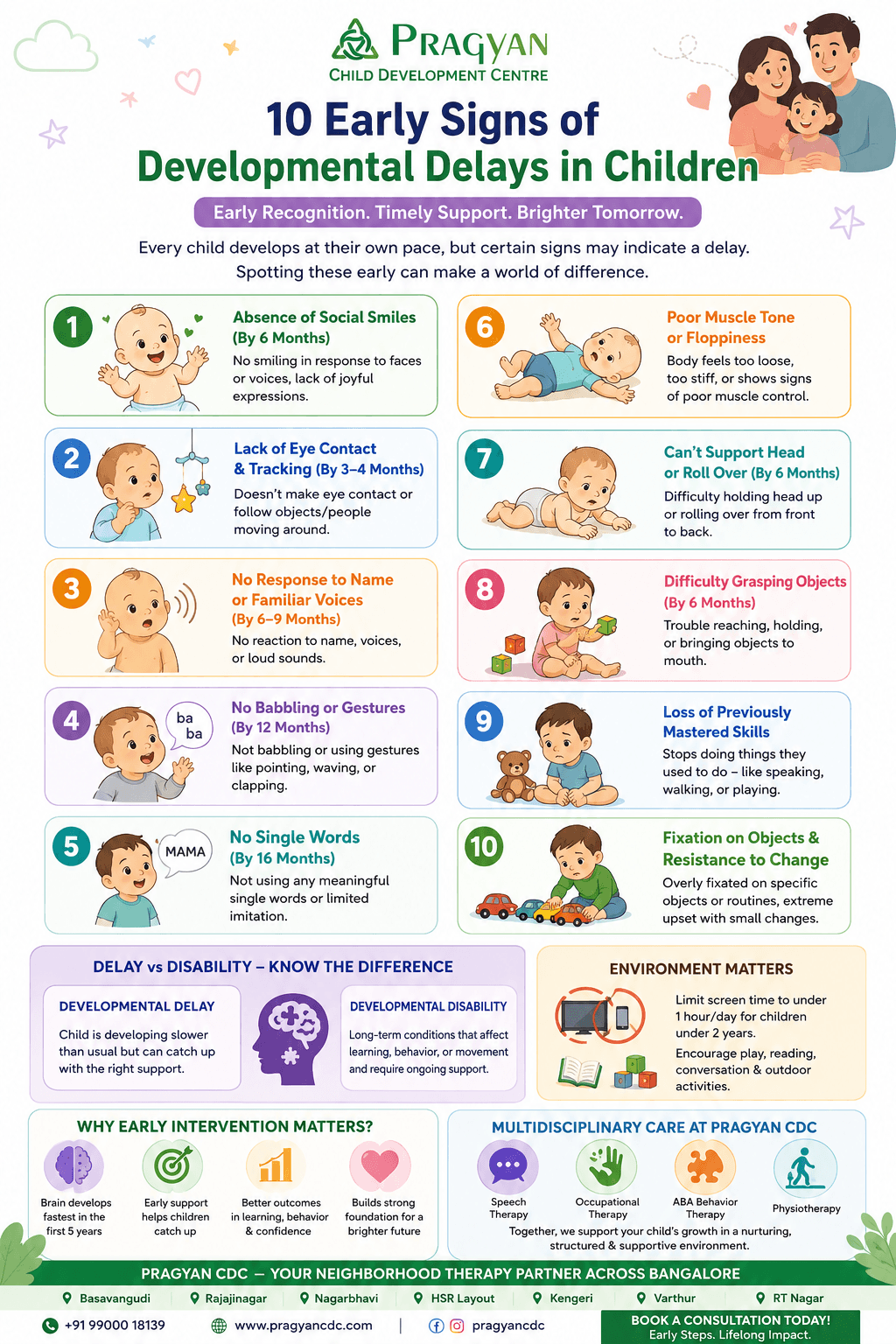
The 10 Critical Early Developmental Delay Signs in a Child
To help you navigate your child’s early growth years, we have broken down the primary warning flags into specific functional tracks. Observing one or more of these signs consistently warrants a professional consultation rather than a “wait-and-see” approach.
1. Absence of Social Smiles or Joyful Expressions (Social-Emotional Domain)
By the age of 2 to 3 months, infants typically begin exhibiting social smiles in response to a parent’s voice or warm facial expressions. If a baby reaches 6 months old without displaying joyful, interactive expressions, reciprocating smiles, or showing shared engagement, it may represent an early variance in social-emotional tracking. This area forms the bedrock for future peer interaction and communication.
2. Lack of Eye Contact and Tracking Objects (Sensory-Cognitive Domain)
Visual engagement is an infant’s primary tool for learning. A child should naturally lock eyes with caregivers during feeding and play, and follow moving visual stimuli by 3 to 4 months. A persistent lack of eye contact, a fixed vacant gaze, or an inability to track objects moving across their field of vision can point to underlying cognitive or sensory processing delays that require direct clinical review.
3. No Response to Name or Familiar Voices (Auditory-Speech Domain)
Between 6 and 9 months, infants learn to turn their heads reliably toward familiar sounds, a mother’s voice, or the distinct calling of their name. If your child appears to frequently “tune out” environmental sounds, fails to startle at loud noises, or shows no orientation when their name is spoken, it is critical to evaluate both auditory function and receptive communication loops.
4. Absence of Babbling or Communicative Gestures by 12 Months (Speech & Language Domain)
Speech development begins long before the first clear word. By 12 months, toddlers should actively practice babbling (producing repetitive syllables like “ba-ba” or “da-da”) and utilize communicative gestures such as waving goodbye, pointing to desired objects, or shaking their head. The absence of these pre-verbal expressions is one of the most prominent indicators of early speech and language delays.
5. Inability to Produce Single Words by 16 Months (Speech & Language Domain)
While every child’s expressive timeline varies, the medical baseline expects a child to utilize distinct, meaningful single words (beyond simple imitation) by 16 months. If a toddler is not using single words or struggles severely with vocal imitation by this age, a comprehensive evaluation by specialists in pediatric speech language pathology can pinpoint structural articulation or processing bottlenecks.
6. Poor Muscle Tone, Floppiness, or Rigid Limbs (Gross Motor Domain)
Physical development relies heavily on proper muscle tone. Parents should observe if their baby’s body feels excessively loose or “floppy” (resembling a ragdoll when held) or, conversely, highly rigid, stiff, and resistant to comfortable movement. These structural signs point to gross motor vs fine motor delays and affect the entire timeline of physical milestones.
7. Inability to Support Head or Roll Over by 6 Months (Gross Motor Domain)
Mastering gross motor milestones follows a top-down structural pattern. A baby must first develop neck strength to hold their head independently, followed by core strength to roll over. If an infant struggles to support their head when sitting with support or cannot roll from front to back by 6 months, targeted physical enrichment is essential to establish balance and spatial mobility.
8. Difficulty Grasping Objects or Bringing Hands to Mouth (Fine Motor Domain)
Fine motor skills involve the coordination of small muscle groups within the hands and fingers. By 6 months, a child should actively reach out, grasp rattles or toys, and guide objects accurately toward their mouth. If a child ignores toys, uses only one hand preferentially before 12 months, or cannot hold small objects, it signals a fine motor bottleneck that impacts school-readiness and basic daily activities.
9. Drastic Loss of Previously Mastered Skills (Regression Track)
One of the most urgent warning flags in pediatric development is developmental regression. If a toddler was previously babbling, speaking specific words, walking independently, or executing clear social interactions, and suddenly stops doing so over a period of weeks, it requires immediate professional intervention. Skill regression is never a standard variant of normal growth.
10. Persistent Fixation on Single Objects and Extreme Routine Resistance (Behavioral Domain)
While toddlers naturally enjoy repetitive play, an intense, unyielding fixation on spinning wheels, lining up toys for hours, or exhibiting catastrophic emotional breakdowns over minor routine changes can indicate behavioral variances. Recognizing these tendencies early helps differentiate general delays from specific neurodevelopmental profiles.
Delay vs. Disability: Clarifying the Diagnostic Landscape
It is deeply vital for parents to recognize that a developmental delay is not automatically synonymous with a lifelong disability. A developmental delay implies that a child is moving slower than the standard chronological path but possesses excellent potential to catch up with proper guidance.
Conversely, a developmental disability refers to long-term neurodevelopmental conditions such as Autism Spectrum Disorder (ASD), Cerebral Palsy, or Down Syndrome. Clinical assessments conducted by experts ensure that children receive customized therapeutic mapping rather than vague, sweeping labels.
The Role of Screen Time and Environmental Factors in Modern Delays
In today’s hyper-digital world, excessive exposure to smartphones, tablets, and television represents a rising cause of secondary language and social delays. When young children spend hours absorbing passive screen entertainment, they miss vital, real-time conversational turn-taking with parents.
Pediatric guidelines strongly advise limiting total screen exposure to under one hour per day for children under two. Prioritizing physical play-dough activities, reading picture books aloud, and engaged playground interaction forms the natural foundation for healthy fine motor and social development.
Why Waiting is Not an Option: The Power of Early Intervention Services
The phrase “he will grow out of it” is one of the most detrimental pieces of passive advice a family can follow. A child’s brain undergoes its fastest, most adaptable period of neural growth during the first five years of life. This phenomenon, known as neuroplasticity, means that early intervention services are vastly more effective than therapies started later in childhood.
By introducing playful, structured infant stimulation or behavioral therapy at the first sign of a lag, you can proactively rewrite your child’s developmental trajectory. Waiting simply allows structural gaps to widen as academic and social demands increase with school entry. Consulting a pediatric specialist for developmental tracking or advanced pediatric speech language pathology in Bangalore ensures that gaps do not widen unmitigated.
The Multidisciplinary Care Framework at Pragyan CDC Bangalore
At Pragyan Child Development Centre, we understand that addressing developmental delays requires looking at the whole child rather than treating challenges in isolated silos. For instance, a child dealing with speech and language delays might also experience underlying sensory overloads or emotional frustration.
Our unified clinical model brings together a certified board of specialists spanning pediatric speech-language pathology, occupational therapy, ABA behavior modification, and pediatric physiotherapy. We deliver this comprehensive medical depth directly within accessible neighborhood hubs across Bengaluru including Basavangudi, Rajajinagar, Nagarbhavi, HSR Layout, Kengeri, Varthur, and RT Nagar. By removing the stress of long city commutes, we guarantee the strict clinical consistency your child needs to master real-world milestones successfully.
Frequently Asked Questions:
Q1: What is the main difference between a developmental delay and a developmental disability?
A: A developmental delay means a child is acquiring specific skills (such as walking or speaking) at a slower pace than standard baselines, but can catch up with targeted support. A developmental disability involves long-term, structural neurodevelopmental conditions (like ASD or cerebral palsy) that require lifelong management and adaptive strategies.
Q2: At what age can you reliably detect developmental delay signs in a child?
A: Signs can be noticed as early as 3 to 6 months of age through tracking infant milestones like eye contact, social smiling, and head control. Regular developmental screenings during pediatric checkups are excellent for identifying subtle variances early.
Q3: Can speech and language delays resolve on their own without professional therapy?
A: While mild language variances occasionally catch up naturally, persistent gaps rarely resolve without expert structural guidance. Relying on advanced pediatric speech language pathology ensures the child corrects underlying oral-motor, articulation, or receptive deficits efficiently.
Q4: How do gross motor vs fine motor delays differ in daily life?
A: Gross motor delays involve large muscle movements, such as rolling over, sitting, crawling, or running. Fine motor delays affect small muscle groups in the fingers and hands, manifesting as difficulties with grasping toys, using utensils, drawing, or buttoning clothes.
Q5: What exactly happens during early intervention services?
A: Early intervention involves a customized mix of playful, scientifically validated therapies designed for infants and toddlers. This includes infant stimulation, speech therapy, occupational therapy, and sensory integration tailored to accelerate a child’s specific developmental timeline.
Q6: Where can I find the best child development centre in Bangalore for early interventions?
A: Pragyan CDC operates a premium network of neighborhood therapy hubs across Bangalore (including Basavangudi, Rajajinagar, Nagarbhavi, and Varthur) specializing in speech therapy, occupational therapy, ABA behavior modification, and early intervention programs.
Q7: How do I book an initial screening consultation at Pragyan CDC Bangalore?
A: You can easily book a comprehensive consultation and baseline developmental assessment by visiting our website at www.pragyancdc.com or reaching out to your nearest neighborhood Pragyan CDC hub directly. Our team provides transparent, data-driven milestone tracking to empower your child’s journey.
Conclusion: Taking the First Proactive Step for Your Child
Noticing developmental delay signs in a child can feel emotionally overwhelming, but recognizing these signals is the ultimate act of protective parenting. Remember, milestones are guidelines, not rigid deadlines yet swift clinical consistency makes all the difference.
By partnering with a multidisciplinary clinical team that understands gross motor vs fine motor delays, sensory needs, and language milestones, you give your child the absolute best framework to unlock their full potential. Trust your parental instincts. Reach out to Pragyan CDC today to build a bright, confident tomorrow for your little one.