As a parent, few moments bring as much joy as hearing your child’s first words. From early babbling sounds to clear phrases, speech development represents a vital milestone in early childhood. However, when a toddler remains silent while peers of the same age are speaking in sentences, parents naturally experience concern and uncertainty.
Is my child just a late talker who will catch up naturally? Or is this an early warning sign of a developmental speech delay?
Navigating communication development in an urban setup like Bangalore presents unique dynamics. Between multi-generational households, bilingual or trilingual environments (English, Kannada, Hindi, Tamil), and increased exposure to digital screens, determining what is normal can be challenging.
This comprehensive guide breaks down age-specific speech milestones, identifies critical red flags, clarifies common root causes, and explains how consulting an RCI-registered speech therapist in Bangalore at a specialized child development centre in Bangalore like Pragyan CDC can support your child’s communication growth.
Understanding Speech vs. Language: The Clinical Difference
Before evaluating milestones, it is helpful to clarify two concepts that are often conflated: Speech and Language.
+--------------------------------------------------+--------------------------------------------------+
| SPEECH (The Motor / Physical Act)               | LANGUAGE (The Cognitive / Symbolic System)       |
+--------------------------------------------------+--------------------------------------------------+
| How we produce sounds and words.                 | How we understand and use words to communicate.  |
| • Articulation (making clear sounds like 'p', 'r')| • Receptive Language (understanding what is said)|
| • Fluency (smooth rhythm, absence of stuttering) | • Expressive Language (combining words together) |
| • Voice (pitch, volume, and vocal cord quality)  | • Pragmatics (social communication & eye contact)|
+--------------------------------------------------+--------------------------------------------------+
A toddler can have a speech delay (knowing what they want to say but struggling to form physical sounds) or a language delay (struggling to understand words or organize thoughts into phrases). Many children experience a combination of both, which is why early assessment at a dedicated early intervention centre in Bangalore is beneficial.
Toddler Speech & Language Milestones: Age-by-Age Guide
While every child develops at their own pace, communication milestones follow a clear developmental sequence. Use this checklist to monitor your child’s progress.
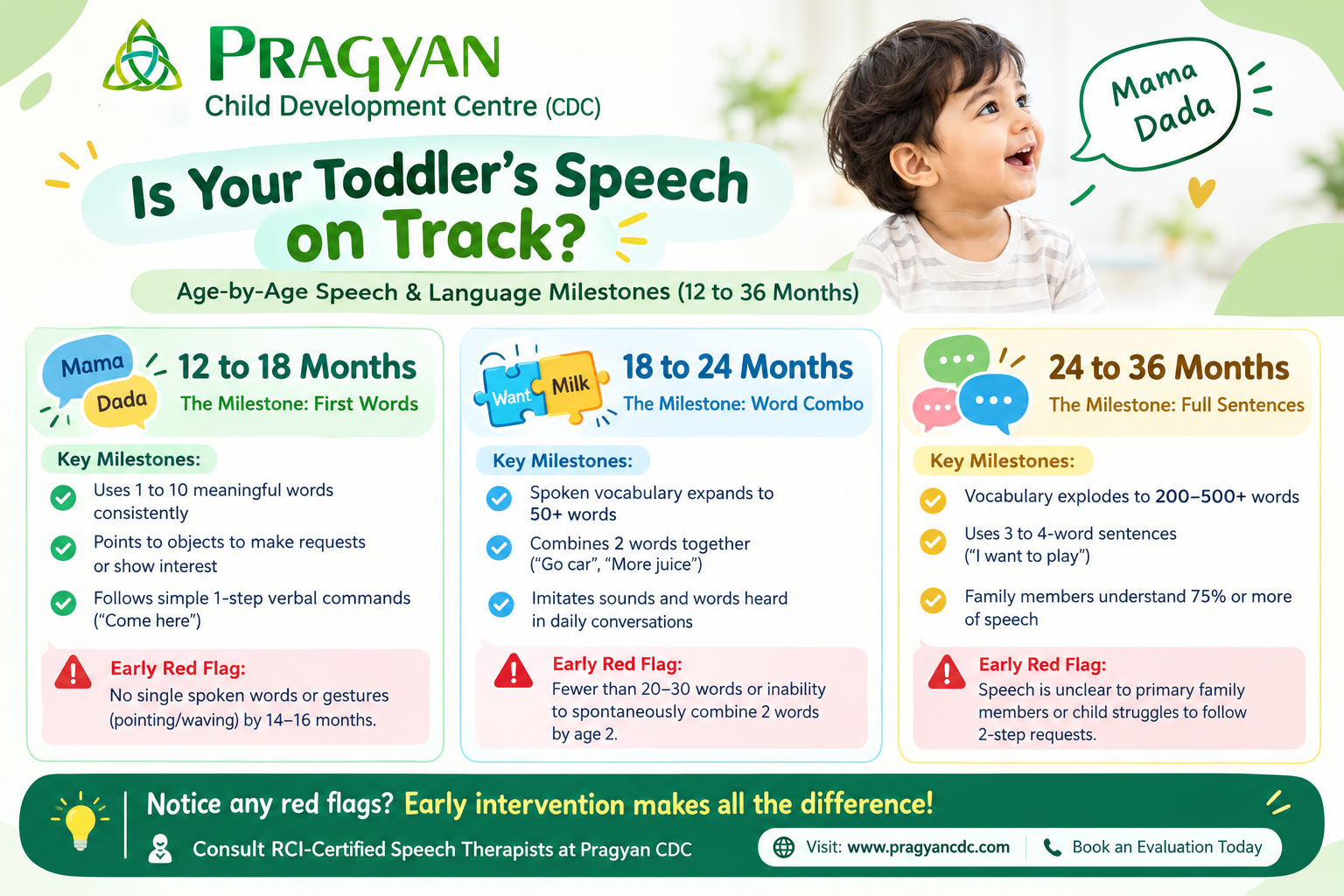
       [ 0–12 Months ]               [ 12–18 Months ]              [ 18–24 Months ]              [ 24–36 Months ]
    • Cooing & Babbling           • 1 to 10 Spoken Words        • 50+ Spoken Words            • 200–500+ Words
    • Reacts to Sounds            • Points to Desired Items     • 2-Word Phrases ("More milk")• 3 to 4 Word Sentences
    • Responds to Name            • Follows 1-Step Commands     • Imitates Daily Sounds       • 75%+ Speech Clarity
1. 0 to 12 Months: Building the Pre-Linguistic Foundation
Long before first words emerge, infants communicate through gaze, gestures, and vocalization.
0–3 Months: Coos, makes soft vowel sounds (“ohh,” “ahh”), smiles in response to familiar voices.
4–6 Months: Experiments with vocalization, laughs, babbles with consonant sounds (“ba-ba,” “ma-ma”).
7–12 Months: Combines different syllables (“ba-da-ma”), turns toward name calls, uses non-verbal gestures like waving “bye-bye” and pointing to toys.
2. 12 to 18 Months: The Emergence of First Words
During this phase, sound play transitions into meaningful symbolic communication.
12–15 Months: Uses 1 to 3 meaningful words consistently (e.g., “Mama,” “Dada,” “Ball”). Understands simple commands like “Come here.”
15–18 Months: Vocabulary expands to 10–20 words. Points to body parts when asked. Uses gestures accompanied by vocal sounds to make requests.
3. 18 to 24 Months: The Vocabulary Explosion
This period represents a major transition in language acquisition.
18–21 Months: Spoken vocabulary reaches 20 to 50 words. Imitates words heard in daily conversation.
21–24 Months: Vocabulary expands to 50+ words. Begins combining two words together (e.g., “Go car,” “Want juice,” “Big dog”). Family members should understand approximately 50% of what the toddler says.
4. 24 to 36 Months: Functional Sentence Building
Speech becomes the primary tool for social interaction, learning, and self-expression.
24–30 Months: Uses 3-word combinations. Refers to self by name or pronoun (“I,” “Me”). Follows two-step instructions (e.g., “Pick up the ball and put it in the basket”).
30–36 Months: Vocabulary grows to 200–500+ words. Asks “Why?” and “Where?” questions. Unfamiliar listeners should understand 75% or more of the child’s speech.
Late Talker vs. Speech Delay: How to Spot the Difference
A common dilemma for parents is distinguishing between a late bloomer and a child requiring clinical intervention.
+--------------------------------------------------+--------------------------------------------------+
| THE LATE TALKER PROFILE                          | THE CLINICAL SPEECH DELAY PROFILE                |
+--------------------------------------------------+--------------------------------------------------+
| • Under 24 months with fewer words than average. | • Persistent speech/language deficit past 24 mos.|
| • EXCELLENT Receptive Language (understands all).| • Struggles to understand simple instructions.   |
| • Strong non-verbal communication (gestures).    | • Limited use of non-verbal pointing or gestures.|
| • Good social eye contact and joint attention.   | • Minimal eye contact or poor joint attention.   |
| • Spontaneously imitates play and actions.       | • Struggles with social interaction with peers.  |
+--------------------------------------------------+--------------------------------------------------+
Clinical Note: While roughly 50% of late talkers catch up on their own by age 3, the remaining 50% experience ongoing speech, language, or learning difficulties. Waiting without guidance carries risks. Seeking an assessment for pediatric speech therapy in Bangalore provides clarity and targeted support.
10 Critical Red Flags: When to See a Speech Therapist in Bangalore
If your child exhibits any of the following indicators, schedule an evaluation with an RCI-certified speech therapist in Bangalore:
[ Red Flag 1 ] -> No babbling, smiling, or social responsiveness by 12 Months.
[ Red Flag 2 ] -> No gestures (pointing, waving, reaching) by 14 Months.
[ Red Flag 3 ] -> No consistent single words by 16 to 18 Months.
[ Red Flag 4 ] -> Vocabulary remains under 50 words by 24 Months.
[ Red Flag 5 ] -> Inability to produce spontaneous 2-word phrases by 24 Months.
[ Red Flag 6 ] -> Difficulty understanding simple verbal requests by 24 Months.
[ Red Flag 7 ] -> Speech is unclear to primary caregivers at 30 Months.
[ Red Flag 8 ] -> Lack of eye contact, social interest, or response to name.
[ Red Flag 9 ] -> Frequent frustration, tantrums, or pulling hands to communicate.
[ Red Flag 10]-> REGRESSION: Loss of any previously acquired words, sounds, or social skills.
Root Causes of Speech Delays in Toddlers
Understanding the root cause of a speech delay guides the choice of therapeutic approach:
1. Hearing Impairment & Middle Ear Conditions
Speech development relies directly on hearing clarity. Undetected hearing loss, persistent fluid in the middle ear (otitis media), or frequent cold infections can distort sound perception. A diagnostic audiological evaluation or BERA (Brainstem Evoked Response Audiometry) test helps rule out hearing difficulties.
2. Neurodevelopmental Conditions (Autism Spectrum Disorder, ADHD)
Communication delays are frequently an early indicator of Autism Spectrum Disorder (ASD). Children on the autism spectrum may show delayed speech alongside challenges in joint attention, eye contact, and social pragmatics. Combined support featuring speech therapy and ABA therapy in Bangalore helps address these core developmental areas.
3. Oral-Motor Deficits & Anatomical Variations
Some toddlers have difficulty coordinating the lip, tongue, and jaw movements required for speech. Conditions like tongue-tie (ankyloglossia), low muscle tone (hypotonia), or motor planning issues (Childhood Apraxia of Speech) require targeted pediatric speech therapy in Bangalore.
4. Urban Lifestyle Factors: Screen Time vs. Multilingual Homes
Excessive Screen Usage: Research indicates that excessive passive screen time (smartphones, TVs, tablets) under age 2 is linked to delays in expressive speech. Screens offer one-way stimulation without the interactive give-and-take essential for language learning.
Multilingualism Myth: Raised in a home where multiple languages are spoken (e.g., Kannada, English, Hindi)? Multilingualism does not cause speech delays. While bilingual toddlers may mix languages initially, their total conceptual vocabulary across languages matches that of monolingual peers.
The Diagnostic Roadmap: What Happens During an Evaluation?
Seeking professional support at a trusted child development centre in Bangalore involves a structured, family-friendly assessment process:
+---------------------------------------------------------------------------------------------------+
| STEP 1: Detailed Clinical & Case History Interview                                                |
| Reviewing prenatal history, developmental milestones, home environment, and medical background.    |
+---------------------------------------------------------------------------------------------------+
                                                 │
                                                 ▼
+---------------------------------------------------------------------------------------------------+
| STEP 2: Hearing Screening & Oral-Motor Examination                                                |
| Assessing physical auditory responses and evaluating lip, tongue, jaw, and palate function.      |
+---------------------------------------------------------------------------------------------------+
                                                 │
                                                 ▼
+---------------------------------------------------------------------------------------------------+
| STEP 3: Standardized RCI Speech & Language Evaluation                                             |
| Assessing receptive vocabulary, expressive capacity, articulation, and social-pragmatic skills. |
+---------------------------------------------------------------------------------------------------+
                                                 │
                                                 ▼
+---------------------------------------------------------------------------------------------------+
| STEP 4: Customized Individualized Education and Therapy Plan (IEP)                                |
| Setting clear, measurable developmental goals tailored to your child's needs.                    |
+---------------------------------------------------------------------------------------------------+
Comprehensive Speech Delay Treatment at Pragyan CDC
At Pragyan Child Development Centre (CDC), speech delay treatment is tailored to each child’s needs using evidence-based, play-centered strategies:
                   ┌─────────────────────────────────────────┐
                   │    PLAY-BASED LANGUAGE STIMULATION      │
                   │   Naturalistic play to build words      │
                   └────────────────────┬────────────────────┘
                                        │
                   ┌────────────────────┴────────────────────┐
                   │     ORAL PLACEMENT THERAPY (OPT)        │
                   │  Tactile tools to build muscle control  │
                   └────────────────────┬────────────────────┘
                                        │
                   ┌────────────────────┴────────────────────┐
                   │   AUGMENTATIVE COMMUNICATION (AAC)      │
                   │   Visuals & PECS for non-verbal kids    │
                   └────────────────────┬────────────────────┘
                                        │
                   ┌────────────────────┴────────────────────┐
                   │   MULTIDISCIPLINARY COLLABORATION       │
                   │   Combined Speech + OT + ABA Care       │
                   └─────────────────────────────────────────┘
Play-Based Language Stimulation: SLPs use child-led play routines, focused stimulation, and extension techniques to encourage spontaneous vocalization and sentence formation.
Oral Placement Therapy (OPT): For children with oral-motor weakness, targeted tactile cues help build the muscle strength and coordination required for clear speech production.
Augmentative & Alternative Communication (AAC): Picture Exchange Communication Systems (PECS) or digital speech-generating devices give non-verbal children a functional way to communicate while verbal skills develop.
Multidisciplinary Integration: Speech therapy is coordinated with occupational therapy in Bangalore to address underlying sensory processing needs that influence attention and communication.
Why Choose Pragyan CDC: Your Trusted Child Development Centre in Bangalore
Selecting the right partner for your child’s developmental journey makes a meaningful difference. Pragyan CDC offers:
RCI-Registered Specialists: Highly trained, compassionate speech-language pathologists holding recognized BASLP/MASLP qualifications.
Child-Centric Therapy Suites: Bright, sensory-friendly environments designed to put toddlers at ease and make therapy feel like play.
Comprehensive Care Under One Roof: Integrated Speech Therapy, Occupational Therapy, ABA Therapy, Special Education, and Early Intervention services.
Transparent Pricing: Clear session fees and monthly package options, helping families plan for ongoing care without hidden expenses.
Accessible Bangalore Locations: Conveniently located branches across key neighborhoods, including Basavanagudi, Yelahanka, Kalyan Nagar, and Whitefield.
14 SEO-Optimized Frequently Asked Questions (FAQs)
Q1: At what age should a toddler start speech therapy in Bangalore?
A: Children can begin speech therapy as early as 12 to 18 months if red flags are present. Early evaluation by age 2 leads to stronger outcomes because the brain’s language networks are most adaptable during early childhood.
Q2: How do I know if my 2-year-old has a speech delay or is just a late talker?
A: A late talker typically understands commands well, uses gestures effectively, and shows good eye contact despite having few words. A child with a speech delay may struggle with comprehension, offer limited gestures, or show less interest in social interaction.
Q3: What is the cost of speech delay treatment in Bangalore?
A: Speech therapy sessions in Bangalore generally range between ₹800 and ₹2,000 per session. At Pragyan CDC, transparent session rates and monthly packages offer accessible, quality care.
Q4: Does screen time cause speech delay in toddlers?
A: High screen time under age 2 is linked to delays in expressive speech, as passive viewing replaces interactive, back-and-forth verbal communication.
Q5: Will growing up in a multilingual home in Bangalore confuse my toddler?
A: No. Research shows that bilingualism does not cause speech delays. While toddlers may mix languages initially, their overall language processing ability develops normally.
Q6: How long does speech therapy take to show results in children?
A: Many children show measurable progress within 3 to 6 months of consistent weekly sessions, depending on the severity of the delay and home practice consistency.
Q7: Can a child outgrow a speech delay without therapy?
A: While some late talkers catch up on their own, roughly 50% experience lingering communication or academic challenges. Early evaluation provides clarity and timely support.
Q8: What happens during a speech evaluation at a child development centre in Bangalore?
A: An RCI-certified speech therapist reviews case history, conducts an oral-motor exam, assesses understanding and word use through play, and builds an Individualized Education and Therapy Plan (IEP).
Q9: What qualifications should I look for in a speech therapist in Bangalore?
A: Ensure your speech therapist holds a degree in Audiology and Speech-Language Pathology (BASLP or MASLP) and possesses a valid registration number from the Rehabilitation Council of India (RCI).
Q10: How can I help my late-talking toddler express words at home?
A: Model clear, simple language; read interactive picture books; narrate daily activities; limit passive screen time; and respond to your child’s gestures with words.
Q11: What is the difference between speech therapy and occupational therapy?
A: Speech therapy focuses on speech clarity, vocabulary, language comprehension, and communication skills. Occupational therapy addresses motor skills, sensory processing, and daily independence.
Q12: Does Pragyan CDC offer pediatric speech therapy across Bangalore?
A: Yes, Pragyan Child Development Centre provides pediatric speech therapy, occupational therapy, and early intervention across multiple locations in Bangalore.
Q13: Can speech therapy help non-verbal children with autism?
A: Yes. Speech therapists use Augmentative and Alternative Communication (AAC), picture communication systems, and play-based techniques to build functional communication for non-verbal children.
Q14: How can I book a speech evaluation for my child at Pragyan CDC?
A: You can visit the Pragyan CDC Contact Page or contact your nearest branch directly to schedule an assessment.
Take Early Action for Your Child’s Communication Journey
Early childhood is a unique window for brain development. If you suspect your toddler is behind on speech milestones, seeking an assessment early provides peace of mind and gives your child appropriate support.
At Pragyan Child Development Centre, our team of RCI-certified speech-language pathologists is dedicated to helping every child find their voice.
Ready to Take the Next Step?
Website: www.pragyancdc.com
Specialties: Speech Therapy | Occupational Therapy | ABA Therapy | Early Intervention