Communication is the cornerstone of a child’s cognitive, emotional, and social development. Watching your child express their first words, mimic sounds, and share their thoughts is one of parenting’s most rewarding milestones. However, when those expected words are delayed or hard to understand, it can naturally cause anxiety and uncertainty for parents. If you are searching for expert speech therapy in yelahanka or trying to determine when to take a child to a speech therapist, you are not alone—and timely intervention can transform your child’s communication journey.
At Pragyan Child Development Centre, located in North Bangalore, we specialize in comprehensive, evidence-based speech and language therapy for children. Whether you live in Yelahanka New Town, Jakkur, Sahakarnagar, Vidyaranyapura, Kogilu, or along Doddaballapur Road, our dedicated team of pediatric Speech-Language Pathologists (SLPs) at our Yelahanka Centre is here to empower your child to find their voice.
Understanding Speech and Language Therapy for Children
Many parents use the terms “speech” and “language” interchangeably, but in pediatric clinical therapy, they refer to distinct aspects of communication:
Speech refers to the physical production of sounds. It includes articulation (how speech sounds are made), voice clarity, and fluency (the rhythm and flow of speech, such as stuttering).
Language refers to the symbolic system used to convey and receive meaningful messages. Expressive language is how a child uses words and gestures to communicate ideas, while receptive language is how well a child understands spoken directions, questions, and concepts.
Pediatric child speech therapy yelahanka new town addresses both dimensions. A qualified speech therapist in yelahanka evaluates whether a child struggles with mechanical sound articulation, language comprehension, social communication pragmatics, or a combination of these challenges.
Key Developmental Milestones: Is Your Child on Track?
Every child develops at their own individual pace, but standard clinical developmental milestones serve as vital guidelines for early identification of speech delay in children. Identifying developmental gaps early ensures that therapeutic support begins during the window of peak neurological plasticity.
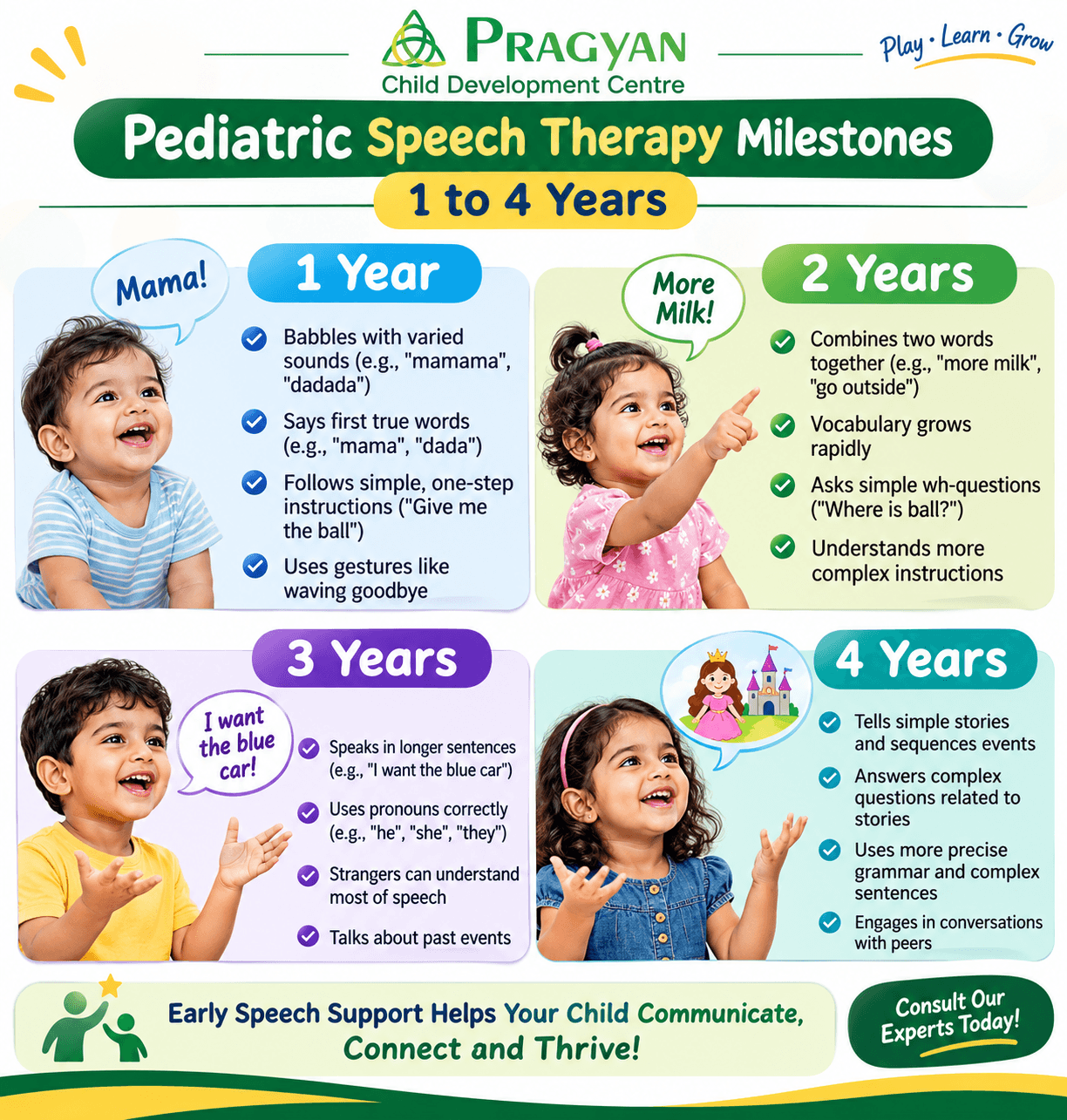
Milestone Checklist (12 Months to 4 Years)
By 12 Months: Babbles with diverse consonant-vowel combinations (ba-ba, ma-ma), responds to their name, uses gestures like waving bye-bye or pointing to objects of interest.
By 18 Months: Uses at least 10 to 20 functional single words, imitates vocalizations, understands simple one-step commands (e.g., “Come here”), and points to familiar objects when asked.
By 24 Months (2 Years): Spontaneously uses at least 50 distinct words, combines two words together (e.g., “More milk”, “Want toy”), imitates sounds, and follows simple instructions.
By 3 Years: Uses 3-to-4-word sentences, has a vocabulary of 200+ words, is understood by family members 75% of the time, and asks simple questions (“Why?”, “Where?”).
By 4 Years: Speaks fluently in full sentences, narrates simple stories, is easily understood by unfamiliar listeners, and correctly uses basic grammar rules.
When to Take a Child to a Speech Therapist: Red Flags & Warning Signs
Parents often wonder: When to take a child to a speech therapist? While temporary fluctuations happen, persistent communication difficulties warrant professional evaluation by a qualified speech therapist near me. Seeking advice early avoids long-term social, academic, and behavioral hurdles.
Addressing a Child Not Talking at 2 Years
A common concern brought to Pragyan CDC is a child not talking at 2 years. While well-meaning relatives may advise to “wait and see,” clinical research strongly demonstrates that waiting past age 2 without an evaluation can delay critical interventions. If a 2-year-old is not using at least 20–50 functional words, does not make steady eye contact, or struggles to imitate sounds, scheduling a professional Developmental Assessment with a specialist is strongly recommended.
Key Red Flags Requiring Professional Consultation:
Lack of Gestures or Eye Contact (9–12 Months): Does not point, wave, or make consistent eye contact during interaction.
No Single Words (by 15–18 Months): Absence of spoken words like “mama,” “dada,” or basic labels.
Difficulty Understanding Language (18–24 Months): Inability to respond to simple requests without visual cues.
Inability to Combine Words (by 24 Months): Uses only single isolated words without attempting two-word combinations.
Loss of Previously Acquired Speech or Social Skills: Any sudden or gradual regression in vocabulary or social engagement.
Excessive Frustration or Behavioral Outbursts: Tantrums stemming from an inability to express needs.
Unclear Speech (3+ Years): Unfamiliar listeners struggle to understand more than half of what the child says.
Common Causes of Speech and Language Delays
A speech delay can stem from various underlying physiological, neurological, or environmental factors. At our premier speech therapy centre north bangalore, we conduct comprehensive assessments to pinpoint the exact root cause:
Hearing Impairment: Middle ear infections (otitis media) or congenital hearing loss can restrict a child’s exposure to auditory language models.
Developmental Delays & ASD: Speech delays are frequently key early indicators of neurodevelopmental conditions like autism, where early therapy is essential. Learn more about our targeted Autism Early Intervention program.
Oral Motor Issues: Weakness or poor coordination in the muscles of the tongue, lips, and jaw (e.g., dysarthria or apraxia of speech).
Structural Differences: Conditions such as lip tie or tongue tie (ankyloglossia) that physically restrict tongue movement.
Environmental Factors: Limited interactive verbal engagement or excessive screen time during early developmental windows.
What to Expect During a Speech Evaluation at Pragyan CDC
Taking your child for an evaluation should be a reassuring, supportive experience. At Pragyan CDC Yelahanka, our assessment process is designed to be child-friendly and play-based:
Detailed Parent Consultation: We gather clinical history, birth milestones, family history, home language dynamics, and specific parental concerns.
Standardization & Observation: Using standardized diagnostic instruments alongside naturalistic play observation to evaluate articulation, expressive/receptive vocabulary, and social interaction.
Oral-Motor Assessment: Examining the physical structure and mobility of the lips, tongue, palate, and jaw.
Customized Therapy Roadmap: Developing an individualized treatment plan with specific, measurable therapy goals tailored to your child’s unique needs.
Tailored Speech Therapy Techniques & Multidisciplinary Integration
Our certified clinicians utilize evidence-based strategies tailored specifically for speech therapy for kids in yelahanka. We believe therapy works best when integrated into play and daily life:
Play-Based Articulation Therapy: Using engaging games, toys, and interactive flashcards to target specific speech sounds in a pressure-free environment.
AAC (Augmentative and Alternative Communication): Introducing visual picture boards, PECS, or digital speech devices for non-verbal children to unlock immediate communication.
Multidisciplinary Support: Because speech delays often overlap with motor planning or sensory processing challenges, our speech therapists collaborate directly with in-house experts in Pediatric Occupational Therapy to deliver holistic care.
Serving Yelahanka New Town & North Bangalore Suburbs
Conveniently located for families seeking a trusted speech therapist in yelahanka or searching online for speech therapy near me, Pragyan CDC serves as a regional center of excellence for North Bangalore. Our state-of-the-art facility near Major Unnikrishnan Road (MD Road) is easily accessible for residents in:
Speech Therapy in Yelahanka New Town & Sector A/B/BEL Layout
Speech Therapy near Jakkur & Thanisandra Corridor
Speech Therapy near Vidyaranyapura & BEL Layout
Speech Therapy near Sahakarnagar & Kodigehalli
Speech Therapy near Kogilu & Hegde Nagar
Speech Therapy near Doddaballapur Road Corridor
Speech Therapy MD Road Yelahanka Center
Frequently Asked Questions (FAQs)
Q1: What is pediatric speech therapy?
Pediatric speech therapy is a specialized clinical intervention that helps children improve their verbal and non-verbal communication skills. It addresses articulation, language comprehension, expressive vocabulary, voice fluency, and social pragmatics.
Q2: How do I know if my child needs speech therapy in Yelahanka?
If your child struggles to meet age-appropriate speech milestones, has difficulty expressing needs, exhibits unclear speech, or displays frustration when trying to speak, an evaluation by a certified speech therapist in Yelahanka is recommended.
Q3: What should I do if my child is not talking at 2 years?
If a child is not talking at 2 years or uses fewer than 20 words, schedule an early evaluation with a pediatric speech-language pathologist. Early intervention produces significantly faster and more sustainable developmental progress.
Q4: Where can I find a qualified speech therapist near me in North Bangalore?
Pragyan CDC offers leading speech therapy in Yelahanka New Town, catering to families across North Bangalore, including Sahakarnagar, Jakkur, Vidyaranyapura, Kogilu, and Doddaballapur Road.
Q5: What causes speech delay in children?
Common causes include fluid buildup in the ear or hearing impairment, developmental delays, autism spectrum disorder (ASD), oral-motor coordination challenges, or structural factors like tongue-tie.
Q6: How long does a typical speech therapy session last?
Standard speech therapy sessions at Pragyan CDC last 45 to 60 minutes, tailored according to the child’s age, attention span, and clinical treatment plan.
Q7: How many speech therapy sessions per week will my child need?
Most children attend 2 to 3 sessions per week. The exact frequency is determined after an initial diagnostic speech evaluation.
Q8: Can speech therapy help with stuttering and stammering?
Yes. Speech-language pathologists utilize fluency shaping and stuttering modification techniques to build smooth, confident speech patterns in children.
Q9: Is speech therapy effective for non-verbal children?
Absolutely. For non-verbal children, therapy incorporates Augmentative and Alternative Communication (AAC), visual picture exchange systems (PECS), and oral-motor play to build functional communication.
Q10: What is the difference between speech delay and language delay?
A speech delay occurs when a child has difficulty forming correct speech sounds or words. A language delay means the child struggles to understand language (receptive) or combine words to express thoughts (expressive).
Q11: How can parents support speech therapy at home?
Parents can support therapy by talking out loud during daily routines, reading interactive books together, limiting screen time, singing rhymes, and practicing home exercises prescribed by the therapist.
Q12: Does screen time contribute to speech delays in toddlers?
Excessive passive screen time (phones, TVs) without interactive human dialogue has been clinically shown to reduce verbal engagement and delay expressive language development in toddlers.
Q13: How long will it take to see progress in my child’s speech?
Progress varies by child. While noticeable improvements often emerge within 8 to 12 weeks of consistent therapy, achieving long-term goals depends on consistency and home practice.
Q14: How do I book a speech therapy evaluation at Pragyan CDC Yelahanka?
You can easily Book a Consultation online or visit our Yelahanka centre located near MD Road.
Take the First Step: Contact Pragyan CDC Yelahanka Today
Every child deserves to feel confident and understood in their communication. If you have concerns about your child’s speech development, early support can make all the difference.
Ready to get started? Book a Speech Consultation today with our expert team at our Yelahanka Centre!